Email Us: pptinspections@hotmail.com
Call Us: (313) 399-7016
Lead-Based Paint Inspection Clearances
When lead hazard reduction or lead paint abatement work has been completed, many property owners assume the home is immediately safe to occupy. However, completing the work is only part of the process. Before occupants return, it's important to verify that lead-contaminated dust has been properly removed through a lead-based paint clearance inspection.
Clearance testing provides confirmation that the work area has been cleaned according to established standards and helps ensure the property is safe for reoccupancy. Whether the project involved renovations, repairs, or lead hazard control, clearance testing is an essential final step in protecting occupants from unnecessary lead exposure.
What Is a Lead-Based Paint Clearance Inspection?
A lead-based paint clearance inspection is performed after lead hazard reduction, abatement, or certain renovation activities have been completed.
The purpose of the inspection is to determine whether the work area has been properly cleaned and whether remaining lead dust is below applicable clearance levels.
A certified inspector typically performs:
A visual inspection of the completed work
Dust wipe sampling from floors, windowsills, and other required surfaces
Laboratory analysis of collected samples
Documentation of the inspection results
Only after the property successfully passes clearance testing should the area be considered ready for normal occupancy.
Why Clearance Testing Is Important
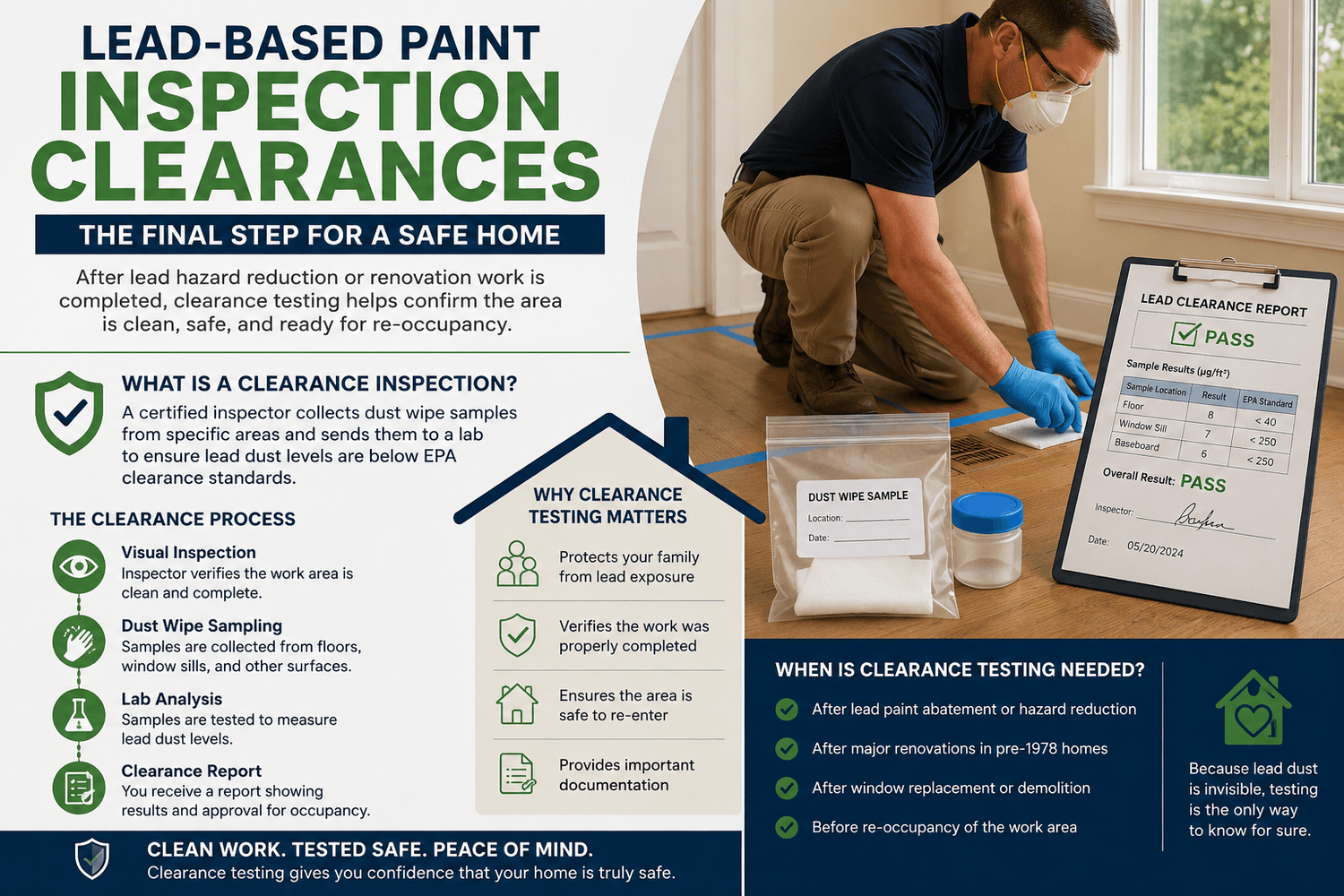
Lead dust is often invisible to the naked eye. Even when a renovation appears clean, microscopic lead particles may still remain on household surfaces.
Without clearance testing, occupants may unknowingly be exposed to hazardous lead dust, especially young children who frequently crawl on floors and place their hands or toys in their mouths.
Clearance inspections help verify that:
The work area has been thoroughly cleaned.
Lead dust levels meet applicable standards.
Occupants can safely re-enter the property.
Contractors and property owners have documentation of completed work.
When Is Clearance Testing Recommended?
Clearance inspections are commonly performed after:
Lead paint abatement projects
Lead hazard reduction work
Major renovations in older homes
Window replacement projects
Extensive paint removal
Certain federally assisted housing projects
Depending on the project and applicable regulations, clearance testing may be required before the property can be reoccupied.
Protect Occupants After the Work Is Finished
Removing lead hazards is only part of protecting a home. Confirming that the property has been properly cleaned provides confidence that the work was completed safely.
At PPT Inspections, we help property owners verify that renovation or lead hazard control work has been completed according to professional standards through thorough lead-based paint clearance inspections.
If you’d like to learn more, click the link below for more information.